Big Sin, Small Sin, and the Unpardonable Sin: Understanding the Degrees of Disobedience in Scripture
This article challenges the common cliché that "all sin is the same," arguing instead that the Bible presents a clear hierarchy of disobedience based on intent, motive, and consequence.
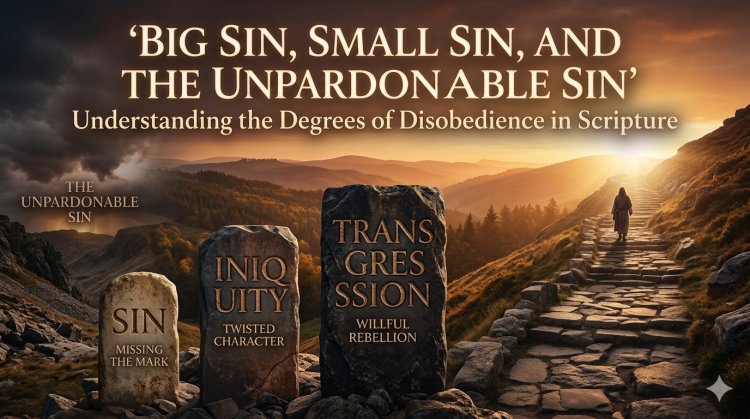
Big Sin, Small Sin, and the Unpardonable Sin: Understanding the Degrees of Disobedience in Scripture
Some people say, almost casually, “Sin is sin—there’s no big sin or small sin.” It’s the kind of statement we toss around to make moral conversations feel simpler, less heavy, and less uncomfortable. After all, if all sins are equal, then no one can claim moral superiority, and no one needs to feel particularly convicted. It sounds fair, balanced, and even humble.
But as we move from the surface-level comfort of that idea into the deeper biblical reality, the tone changes. Scripture does not treat all sins the same. While all unrighteousness is indeed sin, the Bible clearly distinguishes between levels of seriousness, intent, and consequence. Some sins are described as more severe, more corrupting, and more destructive—both spiritually and socially.
This article explores the biblical categories of sin, iniquity, and transgression, and then moves into the sobering territory of the unpardonable sin. The goal is not to condemn, but to understand how God views human behaviour, motive, and rebellion—and why that understanding matters for every believer.
The Biblical Reality: Some Sins Are More Serious Than Others
The Bible repeatedly demonstrates that God evaluates not only actions but motives, circumstances, and intent. Two examples from Scripture illustrate this clearly.
1. Stealing Out of Hunger vs. Heinous Crimes
Proverbs 6:30–31 acknowledges that a person who steals food because he is starving is not despised, though he must still repay what he took. The act is wrong, but the motive softens the moral weight.
2. David and the Consecrated Bread
When David fled from Saul, he and his men were desperate for food. In 1 Samuel 21:1–6, the priest Ahimelech gave David the consecrated shewbread—normally reserved only for priests. Jesus later referenced this event to show that mercy and human need can outweigh ceremonial law. Their need did not make them guilty in God’s eyes.
3. Cities of Refuge: A System Built on Degrees of Guilt
Numbers 35 describes cities of refuge—safe havens for those who killed unintentionally. These individuals were still under threat from the “avenger of blood,” but God provided a system to distinguish accidental killing from premeditated murder. Intent mattered. Malice mattered. Circumstance mattered.
These examples show that God does not flatten all wrongdoing into one category. Instead, Scripture outlines three distinct levels of disobedience:
- Sin
- Iniquity
- Transgression
Each carries a different moral weight and spiritual implication.
Sin: Missing the Mark
The Hebrew word chattah means “to miss the mark.” Sin is falling short of God’s perfect standard—whether through action, thought, or neglect.
Key Features of Sin
- It can be unintentional.
- It includes both commission (doing wrong) and omission (failing to do right).
- It reflects a failure to trust God’s wisdom and authority.
- Even sins of ignorance require atonement (Leviticus 4).
Adam and Eve’s choice in Eden illustrates this: they valued personal desire and intellectual curiosity over God’s counsel, resulting in separation from God and alignment with the “prince of death and darkness.”
Jesus affirmed that ignorance does not remove guilt (Luke 12:47–48). Choosing not to know God’s will—spiritual laziness—is itself sinful.
Iniquity: Twisted Character and Deep Moral Corruption
Iniquity (avon) goes deeper than sin. It refers to a bent, twisted, or crooked moral condition—a corruption of the heart that repeatedly produces sinful behaviour.
Characteristics of Iniquity
- It is premeditated and often planned (Micah 2:1).
- It reflects an inner moral distortion.
- It carries guilt and consequences within the very meaning of the word.
- It separates a person from God (Isaiah 59:2).
David acknowledged this deep-rooted condition in Psalm 51:5: “Surely I was brought forth in iniquity…”
Iniquity is not merely doing wrong—it is becoming wrong.
Transgression: Willful Rebellion and Betrayal
Transgression (pesha) is the most deliberate form of wrongdoing. It means to cross a known boundary, to rebel, or to betray trust.
What Makes Transgression So Serious?
- It is intentional.
- It violates a known command.
- It breaks covenant relationship.
- It resembles betrayal between close allies or neighbours.
Adam and Eve’s act in Eden was not just sin—it was transgression. They knowingly crossed a line God had drawn. The consequences were catastrophic:
- Spiritual and physical death
- Pain and suffering
- Broken relationships
- A wounded human nature
- Expulsion from Eden
David’s sin with Bathsheba also fits this category. He knowingly violated God’s law, manipulated circumstances, and orchestrated Uriah’s death. His confession in Psalm 51 acknowledges this as pesha—rebellion, not mere error.
Beyond All Three: The Unpardonable Sin
The most sobering category of all is blasphemy against the Holy Spirit, often called the unpardonable sin.
What It Is
Not a single act, but a persistent, deliberate, and malicious rejection of the Holy Spirit’s work and truth.
How Jesus Described It
The Pharisees witnessed Jesus’ miracles—clear evidence of the Spirit’s power—and attributed them to Satan. This was not ignorance. It was not weakness. It was willful, hardened rebellion.
Why It Cannot Be Forgiven
- It rejects the very means by which God brings repentance.
- It hardens the heart beyond responsiveness.
- It persists until death, leaving no room for repentance.
A Pastoral Insight
Those who fear they may have committed this sin almost certainly have not. Concern is evidence of a responsive heart. Those who commit it feel no conviction, no sorrow, and no desire for repentance.
Conclusion: Why Understanding These Categories Matters
Recognizing the biblical distinctions between sin, iniquity, transgression, and blasphemy against the Holy Spirit helps us:
- Understand God’s justice and mercy more clearly
- Recognize the seriousness of deliberate rebellion
- Appreciate the depth of Christ’s atonement
- Guard our hearts from drifting into hardened resistance
God is not arbitrary. He sees the heart, the motive, the intent, and the circumstances. And while all sin separates us from Him, not all sin carries the same weight or consequence.
A deeper understanding leads not to fear, but to gratitude—for a God who judges righteously, forgives abundantly, and warns lovingly.
What's Your Reaction?









![ONLY GOD IS AWESOME [vol. 2]](https://acmtrainingroomltd.com/blog/uploads/images/202603/image_650x433_69aec28018e23.jpg)
![ONLY GOD IS AWESOME [vol. 1]](https://acmtrainingroomltd.com/blog/uploads/images/202603/image_650x433_69a953a6e6425.jpg)