Viewing Politics through the Lens of Faith Theme
This is a powerful and timely article outline. It strikes a necessary balance between the spiritual mandate of the believer and the practical complexities of civic life. By grounding the argument in James 1:27, you move the conversation away from the "culture war" rhetoric and back toward the "weightier matters of the law"—justice, mercy, and faithfulness. To help you flesh out the "Understanding" portion of your message, here are some insights and data points that illustrate the current tension between faith and politics in the modern landscape.
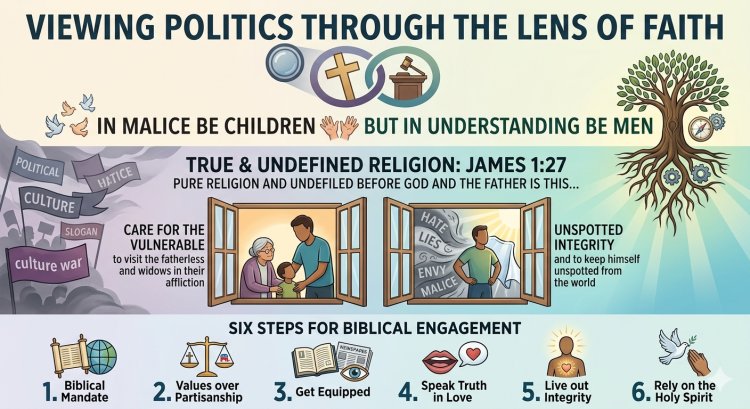
Viewing Politics through the Lens of Faith Theme
“In malice be children, but in understanding be men” (Mature) Preaching Portion: James 1:27 — “Pure religion and undefiled before God and the Father is this, to visit the fatherless and widows in their affliction, and to keep himself unspotted from the world.”
Introduction: In today’s highly polarised and divisive world, nothing seems to be sacred anymore — not even the Word of God. As a result, Scripture is often inaccurately and carelessly brandished, referenced insincerely, and interpreted in ways that are either naïve or outright untrue and dishonouring to Christ. The goal, far too often, is simply to score political points. Thus, the Word of God is no longer primarily used for instruction and healing but rather as a tool for division.
The primary focus in referencing Christianity, faith, or the Bible today seems less about counselling or enlightening and more about radically condemning those with opposing viewpoints. And while it is true that the Christian faith excludes certain actions, Scripture is also clear about how it treats the things it disallows. Even in condemning sin, the Word of God applies its standards equally to all. Christianity’s rule book does not permit its adherents to pick and choose which tenets to uphold and which to ignore — yet many do precisely that.
Today, it has become acceptable among Christians to allow political views to justify delighting in cruelty toward the oppressed, embracing dishonesty, envy, wrath, hatred, and rewarding politicians who wield “power over the other.” At the same time, our modern Christian disposition allows us to leverage grievances to stir up culture wars against sins like abortion and transgenderism, as though these are the only issues that matter to God. Meanwhile, lying, stealing, and malice seem completely acceptable.
But this very approach — excusing some sins while opposing others — runs counter to the practice of true and undefiled religion as described by the apostle James. James insists that there is a standard for religious faith that claims to honour God, and that true followers of God must live by that biblical code. His diligent approach to understanding and applying Scripture is mirrored by Paul’s advice to Timothy: “Study to show thyself approved unto God… rightly dividing the word of truth” (2 Timothy 2:15). Believers are called to handle the Word of God truthfully and accurately, proving themselves faithful workers who need not be ashamed.
This diligent approach is necessary in light of 1 Corinthians 14:20, which urges believers to be innocent and harmless like children when it comes to evil, but mature and discerning in understanding spiritual matters and God’s Word.
The phrase “In malice be children” encourages Christians to be free from ill-will, spite, and deceit — tender-hearted, forgiving, and without bitterness or hypocrisy. The phrase “But in understanding be men/mature” calls for spiritual maturity, deep understanding, and wisdom in divine things.
When viewing politics through the lens of faith, we must confront the fact that God does not have a political party. His kingdom is not of this world. Yet our faith connects us both to God and to the world in which we live and serve. When Jesus invites us into the Kingdom of God, He calls us to let go of our cultural and political biases, prejudices, and ideologies, and to embrace a new way of thinking.
For those deeply immersed in partisan politics, obedience to the gospel — which commands us to love God with all our heart, soul, mind, and strength, and our neighbour as ourselves — often brings discomfort. Nonetheless, we must stop viewing the world through the lens of political identity and begin viewing it through the lens of Jesus.
In today’s sermon text, James highlights that the most vulnerable are of immense importance to God: “Pure religion… is to visit the fatherless and widows in their affliction, and to keep himself unspotted from the world.” Genuine religious practice hinges on selflessness — caring for the marginalised — and spotlessness — avoiding the corrupting influences of the world. These are the same two principles upon which Jesus hangs all the law and the prophets.
In our text, James is not outlining a specific economic method for caring for the poor, but he is unmistakably declaring that caring for the less fortunate must be a priority in our religious duties. Scripture is filled with such admonitions. A few examples include:
Deuteronomy 10:17–20 Zechariah 7:9–10 Isaiah 1:17
Deuteronomy: 10:17-20: For the LORD your God is God of gods, and Lord of lords, a great God, a mighty, and a terrible, which regardeth not persons, nor taketh reward: He doth execute the judgment of the fatherless and widow, and loveth the stranger, in giving him food and raiment. Love ye therefore the stranger: for ye were strangers in the land of Egypt. Thou shalt fear the LORD thy God; him shalt thou serve, and to him shalt thou cleave, and swear by his name.
Zecharia 7:9-10: “Thus has the LORD of hosts said, ‘Dispense true justice and practice kindness and compassion each to his brother; and do not oppress the widow or the orphan, the stranger or the poor; and do not devise evil in your hearts against one another. (vs. 11-14- gives consequence of disobeying this command from God)
Isaiah 1:17: Learn to do well; seek judgment, relieve the oppressed, judge the fatherless, plead for the widow.
Through Scripture, God calls us to look at the world and the issues of our day not through unfettered political bias but through the lens Jesus used when He walked the earth. This lens should govern our thoughts on race relations, immigration, healthcare, climate matters, poverty, abortion, and every other social or political issue. Our understanding and response must be shaped by the wisdom Jesus gives.
Too often, Christians become locked into their chosen political ideology and refuse to allow the words, grace, and wisdom of Jesus to penetrate that worldview. Today, I want to propose six steps — borrowed from Bunni Pounds — to help believers correctly view politics through the lens of faith. My aim is that, in embracing these steps, we may be children in malice but mature in understanding.
1. Understand the biblical mandate for engagement
Jeremiah 29:7–9
In this passage, God instructs His people to seek the welfare of the city where they dwell. Israel had been exiled for disobedience, and God told them to settle in, stop cursing the darkness, shine the light, and recognise that their wellbeing was tied to the wellbeing of the city. Rather than praying for its demise, they were to pray for its peace — because its success would be their success. (And seek the peace of the city whither I have caused you to be carried away captives, and pray unto the LORD for it: for in the peace thereof shall ye have peace. For thus saith the LORD of hosts, the God of Israel; Let not your prophets and your diviners, that be in the midst of you, deceive you, neither hearken to your dreams which ye cause to be dreamed. For they prophesy falsely unto you in my name: I have not sent them, saith the LORD.)
2. Prioritize values over partisan politics
Micah 6:8 The prophet asks what truly pleases God — empty religious performance or justice, mercy, and humility. Christians must examine candidates and policies through a biblical lens, supporting what aligns with Christian values regardless of party affiliation. This requires maturity and critical thinking. (He hath shewed thee, O man, what is good; and what doth the LORD require of thee, but to do justly, and to love mercy, and to walk humbly with thy God?)
3. Get equipped with understanding
1 Corinthians 14:20 (Brethren, be not children in understanding: howbeit in malice be ye children, but in understanding be men.)
Politics, like religion, makes people vulnerable. Charismatic leaders and blatant liars have long learned how to manipulate the vulnerable. Peter warns of false teachers who twist truth for their own agendas (2 Peter 2:1–22). Because of this potential for manipulation, Christians must be knowledgeable, educated, and discerning. We must understand Scripture and also understand the issues affecting society. Billy Graham often said a Christian should preach with the Bible in one hand and a newspaper in the other. We cannot afford to be lazy.
4. Speak the truth in love
Ephesians 4:14–32 We must engage respectfully, even in disagreement. Speaking the truth in love requires maturity, self-control, and a commitment to edifying others rather than tearing them down.
5. Live out integrity
1 Timothy 4:12 Political involvement must never compromise our integrity. Christians do not cease to be Christians when engaging in politics. We must reflect Christ in honesty, humility, compassion, and purity — admitting mistakes and learning from them.
6. Rely on the Holy Spirit
John 15:5 God is the ultimate power in human affairs. Our political engagement must be rooted in abiding in Christ, guided by the Holy Spirit, grounded in Scripture, and sustained by prayer. Without Him, we can do nothing.
What's Your Reaction?








![ONLY GOD IS AWESOME [vol. 1]](https://acmtrainingroomltd.com/blog/uploads/images/202603/image_650x433_69a953a6e6425.jpg)