ACM TEACHING ON THE BOOK OF EPHESIANS: SIT — WALK — STAND
This teaching summarizes Ephesians through three movements: Sit, Walk, and Stand. Believers first sit by embracing their identity and spiritual blessings in Christ (Chapters 1–3). They then walk by living out that identity through holy conduct and submission (Chapters 4–6:9). Finally, they stand firm against spiritual warfare (Chapter 6:10–20).
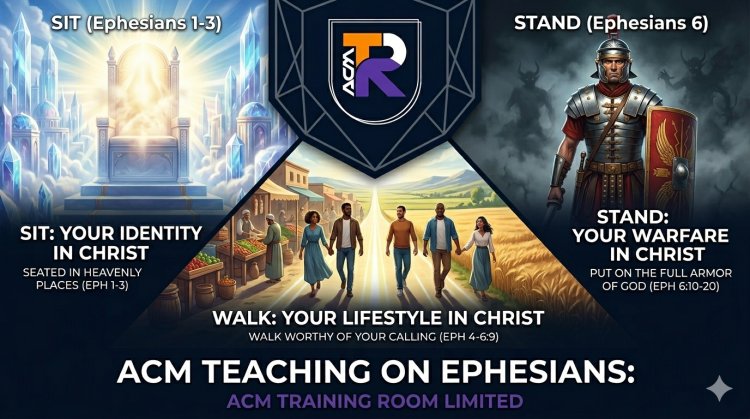
ACM TEACHING ON THE BOOK OF EPHESIANS: SIT — WALK — STAND
Ephesians 1–3 — SIT: (Seated in Heavenly Places in Christ) Our identity in Christ
Commentators consistently agree that Ephesians begins by establishing our identity in Christ. Paul’s declaration that we are seated together in heavenly places in Christ tells us who we are, what we are, where we are, and what our hope is. In a sense, it is “identity politics” in its truest, most biblical form.
Paul opens with a sweeping description of what God has done for us in Christ:
“Blessed be the God and Father of our Lord Jesus Christ, who hath blessed us with all spiritual blessings in heavenly places in Christ…” (Ephesians 1:3–23 KJV)
Paul is not careless in beginning his teaching on spiritual warfare with our position in Christ. He is deliberate and strategic. If we are to be successful in spiritual conflict, we cannot ignore this foundational truth.
According to Ephesians 1, because of our identity in Christ, Paul says we are:
- Blessed with every spiritual blessing (v. 3)
- Chose to be holy and without blame (v. 4)
- Predestined (v. 5)
- Adopted as sons (v. 5)
- Accepted in the Beloved (v. 6)
- Redeemed through His blood (v. 7)
- Forgiven of sins (v. 7)
- Given wisdom and understanding of His will (vv. 8–9)
- Given an inheritance (v. 11)
- Made to bring praise and glory to God (v. 12)
- Sealed with the Holy Spirit (v. 13)
- Guaranteed an inheritance until final redemption (v. 14)
How we stand in spiritual warfare is rooted in the fact that we are seated in Christ. This reality makes us spiritually unassailable. Spiritual warfare is not primarily about technique, special prayers, or psychological exercises related to the armor of God in Ephesians 6. It is about resting confidently in what Christ accomplished at Calvary.
Ephesians urges us to live daily in the power of everything God has done—even when life is difficult. The real struggle is to remain settled in the finished work of Jesus. That is the frontline of spiritual warfare. The enemy constantly attacks our minds, seeking to make us doubt our salvation, question our faith, and cast away our confidence—especially when we stumble.
Until we know, understand, and embrace who we are in Christ, we will not stand strong in spiritual warfare. That is why Paul’s teaching on warfare does not begin in Ephesians 6:10. It begins in Ephesians 1. From chapters 1 through 3, Paul lays out our identity in Christ, forming the foundation for our ability to stand against the enemy.
A Brief Look at Ephesians 2 — SIT
“But God, who is rich in mercy, for his great love wherewith he loved us… hath raised us up together, and made us sit together in heavenly places in Christ Jesus.” (Ephesians 2:4–6)
Paul again emphasizes our identity in Christ and reminds us where it came from: God made us sit in heavenly places in Christ Jesus. Our position is not earned; it is given. Paul points the Ephesians back to God’s great love and mercy, which made us alive with Christ even when we were dead in sin (Ephesians 2:5).
Scripture consistently affirms what we were without Christ:
- Dead in trespasses and sins
- Blind (2 Corinthians 4:3–4)
- Slaves to sin (Romans 6:17)
- Lovers of darkness (John 3:19–20)
- Sick and in need of a physician (Mark 2:17)
- Lost (Luke 15)
- Aliens, strangers, and foreigners (Ephesians 2:12, 19)
- Children of wrath (Ephesians 2:3)
- Under the power of darkness (Colossians 1:13)
Paul also reminds believers that the life of spiritual death we once lived—“according to the course of this world”—was orchestrated by Satan and is still active among those who remain in rebellion.
He then reaffirms that our salvation is grounded entirely in God’s mercy and grace. Human effort contributes nothing. As BibleRef notes, this is Paul’s first explicit mention of salvation by grace, a theme he repeats in verses 8–9: “For by grace are ye saved through faith… not of works, lest any man should boast.”
Ephesians 2:10 reinforces our identity: we are God’s workmanship, created in Christ Jesus for good works—works God prepared beforehand for us to walk in.
Reconciliation Through Christ
In verses 11–18, Paul highlights Christ’s work in reconciling all people to God. Gentiles, once “aliens” and “strangers,” have been brought near by the blood of Christ (v. 13). The hostility between Jew and Gentile—rooted in the law—has been abolished through Christ’s death. He fulfilled the law on our behalf and bore the penalty for our failure to keep it.
“For he is our peace… and hath broken down the middle wall of partition between us.” (Ephesians 2:14)
Through Christ, both Jew and Gentile now have access to the Father by one Spirit (v. 18).
A Unified Household
In Ephesians 2:19–22, Paul concludes that all believers—Jew and Gentile alike—are no longer strangers but fellow citizens and members of God’s household. This unified family is built on the foundation of the apostles and prophets, with Jesus Christ as the chief cornerstone. The purpose of this new structure is clear: to become a dwelling place for God through the Spirit.
A Brief Look at Ephesians 3 — SIT
Ephesians 3 unfolds in two movements:
- The mystery of Christ revealed (vv. 1–13)
- Paul’s prayer for spiritual strength (vv. 14–21)
The Mystery Revealed (Ephesians 3:1–13)
Paul explains that the message of salvation being extended to the Gentiles was a mystery hidden from previous generations but now revealed by God through His apostles and prophets. Drawing on his Damascus Road encounter, Paul reminds the Ephesians that he was uniquely called to proclaim this revelation, despite being an unlikely candidate.
“Unto me, who am less than the least of all saints, is this grace given, that I should preach among the Gentiles the unsearchable riches of Christ.” (Ephesians 3:8)
Paul describes himself as a prisoner for the sake of the Gentiles, emphasizing that his suffering is part of God’s eternal plan to make known His manifold wisdom. Because of Christ, he says, we now have boldness and confident access to God through faith (v. 12).
Paul’s Prayer for Strength (Ephesians 3:14–21)
Paul then turns to prayer, bowing his knees before the Father:
“That he would grant you… to be strengthened with might by his Spirit in the inner man; That Christ may dwell in your hearts by faith…” (Ephesians 3:16–17)
He prays that believers would be rooted and grounded in love, able to grasp the vast dimensions of Christ’s love—its breadth, length, depth, and height—and be filled with all the fullness of God. This prayer has become one of the most beloved in Scripture, second only to the Lord’s Prayer in familiarity.
Writers have noted that Paul’s prayer flows from everything he has already taught:
- We bow because of who God is and what He has done
- We pray to remember His sovereignty, grace, and generosity
- We seek strength from the Spirit, the indwelling of Christ, and the fullness of God
Another commentator summarizes the prayer this way: To the Father of the family, for the Spirit’s power, for Christ’s indwelling; grasping what surpasses knowledge; filled to God’s fullness; to God’s eternal glory.
This prayer—famously one of the longest sentences in the Bible—reaffirms Paul’s central theme: we are seated with Christ in heavenly places, and from this position flows our identity, our confidence, and our spiritual strength. Paul’s desire is that believers remain constantly aware of this birthright so they may live filled with the fullness of God.
Ephesians 4:1–6:9 — WALK) Walking in line with our new identity
A Brief Look at Ephesians 4: Walking It Out
In keeping with the structure of the letter—and with what commentators widely affirm—Ephesians 4 shifts from the theme of sitting in Christ to walking in line with our new identity. Followers of Jesus are called to walk worthy of their calling. The blessings and privileges described in chapters 1–3 are meant to shape the daily life of the believer in every sphere: work, family, society, and culture.
“I therefore, the prisoner of the Lord, beseech you that ye walk worthy of the vocation wherewith ye are called.” (Ephesians 4:1)
Ephesians 4 is marked by the repeated emphasis on walk:
- Walk worthy
- Walk in unity
- Walk in purity
- Walk in love
- Walk as children of light
- Walk as wise
- Walk circumspectly
It is a call to every believer—regardless of rank, gifting, or ability—to live a life of purity, dependence, faith, and unity in the Spirit.
Having spent the first three chapters describing in glorious detail all that God has done for us, Paul now urges believers to live in a manner consistent with that reality. His admonition is strong and purposeful: your walk cannot come before understanding your identity and rest in Christ. You must first know that you are seated with Christ in heavenly places, blessed with every spiritual blessing. Only then can you walk worthy of that calling.
Paul describes the character of this worthy walk:
“With all lowliness and gentleness, with longsuffering, bearing with one another in love; endeavoring to keep the unity of the Spirit in the bond of peace.” (Ephesians 4:2–3)
Gifts for the Maturing of the Church
In verses 7–16, Paul outlines the offices of spiritual leadership and their purpose. He highlights the gracious gifts the resurrected and ascended Christ has given to His church: apostles, prophets, evangelists, pastors, and teachers. These gifts are designed:
- To equip the saints for ministry
- To build up the body of Christ
- To bring believers to maturity
- To unify the church in faith and knowledge
- To form Christlike character
“Till we all come in the unity of the faith… unto a perfect man, unto the measure of the stature of the fulness of Christ.” (Ephesians 4:13)
A church grounded in this way will not be easily misled:
“That we henceforth be no more children, tossed to and fro… by the sleight of men.” (Ephesians 4:14)
Instead, by speaking the truth in love, the body grows up into Christ, with every member contributing to the health and development of the whole (v. 16).
Putting Off the Old, Putting On the New
In the latter part of Ephesians 4, Paul provides a blueprint for a transformed life. He insists that believers must no longer walk as they once did:
“In the vanity of their mind… alienated from the life of God… because of the blindness of their heart.” (Ephesians 4:17–18)
In light of what God has already done (Ephesians 1–3), we are to:
- put off the old self
- be renewed in the spirit of our mind
- put on the new self
A life produced by the Spirit will be evident in conduct that reflects God’s character. To remove any ambiguity, Paul lists specific behaviors to avoid and virtues to embrace. The Message paraphrase captures the tone vividly:
- No more lies or pretenses—tell the truth
- Be angry, but do not sin
- Don’t give the devil a foothold
- Stop stealing; work honestly and generously
- Watch your speech—let every word be a gift
- Don’t grieve the Holy Spirit
- Make a clean break with bitterness, rage, and slander
- Be gentle, sensitive, and forgiving—just as God forgave you in Christ
This is what it means to walk worthy of our calling.
Ephesians 5 — KEEP WALKING
Continuing to Walk It Out — A Brief Look at Ephesians 5
Ephesians 5 continues Paul’s theme of the believer’s walk, building directly on the transformation described in chapter 4. Paul instructs believers how to live out the gospel in a manner worthy of their calling. Having already emphasized unity and purity, he now urges them to imitate God by walking in love, light, and wisdom.
“Walk in love, as Christ also hath loved us…” (Ephesians 5:2)
Christ’s sacrificial love becomes the model for Christian living. Believers are also called to “walk as children of light” (v. 8), demonstrating the fruit of the Spirit—goodness, righteousness, and truth.
Walking in Purity
Paul warns that sexual immorality, impurity, and foolish talk—behaviors common among unbelievers—must not be named among God’s people. Believers must neither participate in nor partner with those who practice such things. Instead, they are to discern what pleases the Lord and live accordingly.
“Have no fellowship with the unfruitful works of darkness, but rather reprove them.” (Ephesians 5:11)
Some deeds of darkness are so shameful that Paul advises believers not even to speak of them. As the days grow increasingly evil, Christians must walk wisely and make the best use of their time (v. 15–16).
Walking in the Spirit
Paul contrasts being filled with the Spirit with being drunk with wine. A Spirit-filled life is marked by worship, gratitude, and mutual encouragement:
- Psalms, hymns, and spiritual songs
- Singing and making melody in the heart
- Giving thanks always
- Submitting to one another in reverence for Christ
Walking in Matrimonial Harmony
David Guzik notes another walk emphasized in this chapter: the walk of matrimonial harmony. Paul instructs:
- Wives to respect and submit to their husbands as unto the Lord
- Husbands to love their wives sacrificially, as Christ loved the church
This mutual devotion reflects Christ’s relationship with His bride and becomes a living testimony of the gospel.
Submission — Ephesians 5:21–6:9- Submission as Part of Walking (Ephesians 5:21–6:9)
From Ephesians 5:21 through 6:9, Paul continues the theme of walking in our identity by addressing the often‑misunderstood subject of submission. He begins with a general call:
“Submitting yourselves one to another in the fear of God.” (Ephesians 5:21)
Paul then applies this principle to three relational spheres:
- Marriage
- Family
- Work
Submission in Marriage
Paul starts with the institution of marriage, emphasizing mutual submission between husbands and wives. Wives are called to submit to their own husbands as unto the Lord, and husbands are commanded to love their wives sacrificially—as Christ loved the church and as they love their own bodies.
This is not about inferiority or dominance; it is about reflecting Christ’s relationship with His bride. Paul roots his teaching in the highest example of submission the world has ever seen:
“Who, being in the form of God… humbled himself, and became obedient unto death, even the death of the cross.” (Philippians 2:6–8)
Submission, in its biblical sense, means “to arrange under”—to willingly align with God’s order. It is not meant to diminish anyone but to bring the fullness of Christ into relationships and restore what is broken.
As one writer notes: “Biblical submission is aligning with God’s order. It is not meant to limit someone but to bring the fullness of Christ and God’s restoration to the broken places in life.”
Sometimes the greatest test of character is submitting to someone who may not seem as capable or knowledgeable, yet through whom God chooses to work in a particular moment.
Submission in the Family
Paul carries this theme into chapter 6. Children are instructed to obey their parents, and fathers are warned not to provoke their children to anger but to nurture them in the discipline and instruction of the Lord. Submission here is expressed through honor, responsibility, and loving leadership.
Submission in the Workplace
Paul then addresses servants and masters. Servants are to obey their earthly masters sincerely, not merely as “eye‑servants,” while masters are to treat their servants with fairness, remembering that they too are under the authority of the ultimate Master in heaven.
Submission in this context is not about social hierarchy but about living under Christ’s lordship in every sphere of life. The proof of a master’s submission to God is seen in how he treats those under his authority.
The Spirit‑Filled Life and Submission
Paul’s teaching on submission flows directly from his command to be filled with the Spirit (Ephesians 5:18). A Spirit‑filled believer is one who:
- Walks in love
- Walks in light
- Walks in wisdom
- Walks in submission
Submission becomes a mark of spiritual maturity and a sign that one is living under Christ’s authority.
It is from this posture of Spirit‑empowered submission that Paul transitions into the final section of the letter—STAND. The order is intentional:
SIT → WALK → STAND Identity → Lifestyle → Warfare
Only those who know they are seated with Christ and who walk out that identity daily are prepared to stand against the enemy.
(Ephesians 6:10–20 — STAND)
A Look at Ephesians 6:10–20 — STAND
Having already addressed submission in relationships (Ephesians 6:1–9), Paul now turns to the specific subject of spiritual warfare. Many believers rush to this passage, often overlooking the rest of the letter, but Paul introduces it intentionally at the end of his message.
“Finally, my brethren, be strong in the Lord, and in the power of his might.” (Ephesians 6:10)
The word finally is not a casual transition. As David Guzik notes, Paul speaks in light of everything he has already said. Ephesians 6:10–20 is not a standalone teaching; it is the culmination of the entire letter.
Before discussing warfare, Paul expects us to remember:
- All that God has done for us
- Our glorious standing as children of God
- God’s eternal plan that includes us
- His desire for our maturity and unity
- The conduct He calls us to
- The filling and leading of the Spirit
- Our walk in love, light, wisdom, and submission
Only in light of these truths does Paul address the battle.
The Order Matters: SIT → WALK → STAND
Our overview of Ephesians shows that:
- We are seated with Christ (identity)
- We walk out that identity (lifestyle)
- We stand against the enemy (warfare)
Standing is impossible without walking, and walking is impossible without sitting. Paul warns us not to attempt spiritual warfare without first understanding our position in Christ and living it out daily.
Standing Against the Devil’s Tactics
Paul commands believers to:
- Be strong in the Lord
- Stand firm
- Put on the whole armor of God
This is not about special techniques or mystical rituals. To “put on the armor” means to believe and live out everything Jesus has done for us (Ephesians 1–3) and to walk in those truths daily (Ephesians 4–5).
John Stott, quoting A. B. Simpson, describes Satan’s strategy:
“The tactics of intimidation and insinuation alternate in Satan’s plan of campaign. He plays both the bully and the beguiler. Force and fraud form his chief offensive against the camp of the saints.”
The devil is a tactician—cunning, strategic, relentless. That is why Paul insists we must stand firm in the Lord’s strength and be equipped with God’s armor.
The Real Struggle
Ephesians concludes by reminding us that the real battle is to remain anchored in the finished work of Christ. The enemy’s primary goal is to shake our confidence in what Jesus has already accomplished.
Our victory flows from:
- being seated with Christ
- walking in the Spirit
- standing in God’s strength
A distorted or shallow view of spiritual warfare can distract us from the true source of power. Modern teachings sometimes reduce the armor to a mantra—“I put on the helmet,” “I put on the breastplate”—as if the armor were literal pieces to imagine or mime. But these are not physical items; they are mindsets, truths, and attitudes shaped by the Word of God.
For example, the “sword of the Spirit” is not our sword—it is the Spirit’s sword, the Word of God. We take it into our hearts; He wields it.
As children, we sang songs about “licking down Satan,” but the real battle is far deeper: to stand firm in Christ’s finished work and refuse to be moved.
What's Your Reaction?