A GREATER THAN SOLOMON IS HERE: “Why True Wisdom Begins With Christ”
The sermon argues that modern society mistakenly treats wisdom—like motivational quotes and practical advice—as a self-sufficient guide for life, ignoring God, the actual source of that wisdom. Using the analogy of a car, the author explains that human wisdom is merely the windshield wipers and headlights (it helps you see), but God is the engine (the power that actually moves you). Ultimately, biblical wisdom isn't a self-help checklist; it’s a way for redeemed people to live in response to God's grace. True wisdom is found only in Jesus Christ ("a greater than Solomon"), who offers not just good advice for this earthly life, but eternal life and a transformed heart.
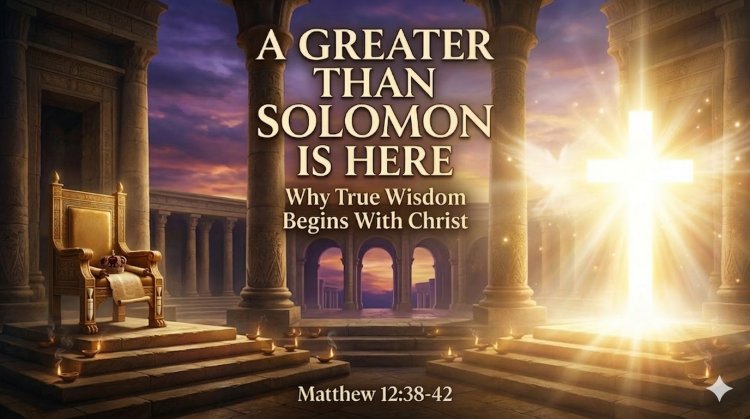
A GREATER THAN SOLOMON IS HERE: “Why True Wisdom Begins With Christ”
Matthew 12:38–42: The Queen of the South… “and behold, a greater than Solomon is here.”
INTRODUCTION:
There is a deception sweeping through our world today. It's subtle. It's attractive. It's dangerous. Many people — intelligent people, successful people — are saying: "We don't need religion. We don't need the Church. We don't need God. All we need are wisdom sayings, practical advice, and ethical principles to live by." They say: "Look at all the division caused by religion. Look at all the hypocrisy in the Church. But wisdom? Wisdom is timeless. Wisdom is practical. Wisdom works." And on the surface, they sound reasonable. They sound wise.
Consequently, our world is overflowing with wisdom sayings in what some call, the age of the "Quote Image." You’ve seen them on Instagram, Facebook, TikTok and Pinterest—a beautiful sunset in the background with some elegant cursive text. Social media feeds, self‑help books, podcasts, and motivational speakers offer us a plethora of proverbs for every situation. “Actions speak louder than words.” “Where there’s a will, there’s a way.” “A journey of a thousand miles begins with a single step.” Or maybe, "Every cloud has a silver lining." These sayings are memorable, practical, and often helpful.
So helpful, in fact, that the number of people who say, I don’t need the 'thou shalts' and 'thou shalt nots' just give me the wisdom, give me the ethics. give me the 'Common Sense' of the ages " grows daily. Ironically, this group, while disparaging other parts of scripture look at the book of Proverbs—and they treat it like a spiritual buffet. These actions reinforce the belief, that they can live well without God — as long as they follow enough “good advice.” In such an environment religion therefore becomes outdated, and unnecessary, while the ‘in-crowd’ cling tightly to wisdom literature from every culture.
But here's the problem: They are building their lives on a foundation that cannot hold them because wisdom cannot sustain itself without the God who gives it.
They want the advice on how to handle their money, how to pick their friends, and how to work hard, but they want to leave the Giver of that wisdom at the door.
They want the "Early bird that catches the worm," but they don't want the God who created both the bird and the worm.
To use the analogy of a car, they are attempting to drive a car without an engine. They are trying to navigate life with windshield wipers, headlights, and side mirrors — but no engine to propel them forward. That is because if your life is a car, wisdom is not the engine as many people may think. Hence it is unwise to think that if you just collect enough wise sayings from Buddha, Confucius, or Solomon, that you can power your way through life. But that is not true, because wisdom doesn’t represent the engine in a car, your breath does:
• Wisdom is the windshield wipers. It clears the glass so you can see the road ahead.
• Wisdom is the headlights. It helps you navigate the dark "topsy-turvy" seasons of life.
• Wisdom is the rearview mirror. It helps you learn from the mistakes behind you so you don't repeat them.
• Wisdom is the dash-cam. It keeps the facts straight when life gets messy.
But listen closely: Wisdom is not the engine. It is not the life in your body, nor the air in your lungs. That "Engine"—the power that actually moves the vehicle of your soul—comes from God and God alone.
You can have the best windshield wipers in the world, but if the engine is dead, you’re just sitting in a shiny car in the middle of the road, looking clearly at a destination you can’t reach. This is why Jeremiah 9:23-24 warns us: "Let not the wise man glory in his wisdom... but let him glory in this, that he understands and knows ME."
So always remember that: Wisdom is not the engine of life — it is the headlights, the mirrors, the wipers, the dashboard indicators. It helps you navigate, but it cannot make the car move.
And this is why Jesus confronted His generation with a stunning declaration: “A greater than Solomon is here.” He was saying: You cannot have wisdom without Me. I am the wisdom of God in human flesh.
Today, therefore, we’re going to look at why the ‘we just need good advice’ or the "Quote Image" approach is not just incomplete—it’s dangerous.
All wisdom — biblical or otherwise — only makes sense when interpreted through the revelation of God, fulfilled in Jesus Christ. Therefore, while the world searches for wisdom, Christians encounter the Wisdom of God Incarnate which is Jesus Christ. In this vein we understand why Jesus said in Matthew 12:42, "A greater than Solomon is here."
1. Wisdom Sayings Are Powerful, Valuable And have Immense Appeal — But They Are Not Enough in themselves.
Cultures across the world treasure wisdom sayings because they distill life’s complexities into concise memorable truths. Some notable sayings and proponents include:
"Your worst enemy cannot harm you as much as your own thoughts unguarded" Buddha,
"Our greatest glory is not in never falling, but in rising every time we fall". Confucius, the great Chinese philosopher.
“All humans are created equal, requiring the elimination of all prejudice (racial, gender, class)”. And “Abandon not the everlasting beauty for a beauty that must die, and set not your affections on this mortal world of dust”. Baháʼu'lláh.
Or the wisest of them all Solomon who said: "As iron sharpens iron, so a friend sharpens a friend". And "He who walks with the wise grows wise, but a companion of fools suffers harm".
All these saying offer:
Practical guidance — How to navigate relationships, work, finances
Ethical direction — What is right and wrong
Comfort in suffering — Acknowledging that life is sometimes "topsy-turvy"
Timeless relevance — Ancient wisdom that still applies today
All truths that guide our decisions, relationships, work, character, suffering, uncertainty, and the chaotic and messy nature of life.
Yet wisdom sayings — whether from Solomon and the book of Proverbs, Buddha, Confucius, Baháʼu'lláh writings, or modern motivational speakers — cannot stand alone. They were all spoken within a worldview, a story, a theological context.
Biblical wisdom especially, assumes you already know:
- God’s covenant in the Law
- God’s character and His plan for salvation
- The story of creation, fall, and promise
- The messages of the prophets
- The worship and theology of the Psalms
Without this foundation, Proverbs becomes detached advice rather than covenant instruction.
2. Because Wisdom Literature, presumes knowledge of the past, the Proverbs is not the starting point it is the result.
What do I mean? The book of Proverbs in scripture, is arguably the most practical book in the Bible. It tells you how to talk to your neighbor, how to avoid a fight, and why you shouldn't sleep until noon. But here is the mistake many people make: they read Proverbs as a "Starting Point." But it is not, something else was said before it.
In the layout of the Hebrew Scriptures, the book of Proverbs is preceded by the books of the Law- Genesis to Deuteronomy, the writings of the former prophets Joshua, Judges, Samuel, Kings, then the latter prophets also called major prophets Isiah, Jeremiah, Ezekiel, and the twelve minor prophets. The law sets forth the principles on the covenant and the ideal life to be experienced by following the principles of the covenant. The former and major prophets show the failure of the covenant people to experience this ideal in history, whereas the latter or minor prophets provide divine interpretation of this failure in history. Note therefore that it is only after the Law and the prophets that the proverbs which is the third and final section of the Hebrew writings occur.
According to scholars, the overall function of this section is to teach the covenant community how to live out the ideals set out in the law, but which were not experienced in the prophets.
In other words, the proverbs or wise sayings are not wisdom literature or wise saying merely for the sake of it. The context is to guide God’s people in living out God’ redemptive plan. The reason why the book of proverbs doesn’t contain explicit teaching on redemptive history is because the knowledge of such is presumed. This therefore means that the principles taught in proverbs are not to be lived out as legalistic rules but as a response to Gods redemptive work in the past which he accomplished behalf of the community. For those of us in the New Testament this means that today we strive to live out the principles of proverbs/ wisdom sayings as our response to God’s redemptive work in Jesus Christ. This approach answers that age old question of how then we should live in light of the revelation we have received.
Therefore, Proverbs is not a starting point. It is a result. When you open Proverbs, the Bible presumes you’ve already done your homework. • It presumes you know the Law (the Torah)—that God has a covenant with His people and a standard of holiness.
• It presumes you know the Prophets—that we have failed that standard and need repentance.
• It presumes you’ve walked through the Psalms—that you know how to weep, pray, and worship.
And in the light of that preceding knowledge, as you read proverbs or wisdom sayings. you will then know how to apply the message of the proverbs. You cannot therefore live out the messages of Proverbs, Job, or Ecclesiastes without first understanding the rest of the Book. Why? Because context is the anchor. Without the anchor of God’s redemptive history—the story of the seed of the woman in Genesis and the promised Messiah—wisdom becomes nothing more than "self-help." And self-help is a broken ladder; it might get you off the ground, but it will never get you to heaven.
Without these prerequisites, or list of things the book of proverbs presumes the reader knows before delving into the proverbs, humanity remains stuck. It explains Why You Can’t Skip the "Old" to Get to the "Wise". To the Hebrew mind, the order of the books isn't random; it’s a divine progression. Imagine trying to use a high-tech GPS (Wisdom) without having an engine in the car or a map of the territory (The Law and Prophets). It just doesn't work.
A. The Foundation: The Law (Torah)
Before Proverbs tells you how to treat your neighbor, the Law (Genesis to Deuteronomy) establishes who you are and Whose you are. * It sets the holy standard. It reveals God’s holiness, humanity’s sin, and the need for a Savior.
It reveals God’s righteous nature.
It exposes our inability to be "good enough" on our own.
The Point: You can’t be "wise" until you realize you are a sinner in need of a Covenant-keeping God.
B. The Diagnosis: The Prophets (Major & Minor)
If the Law is the "Standard," the Prophets are the "Mirror." The Prophets (major and minor) explain Israel’s failure, God’s judgment, and His promise of restoration. The Major Prophets (Isaiah, Jeremiah, Ezekiel) showed us the failure of God’s people to keep the covenant. But then we have the "Minor Prophets"—the twelve voices that act like a spiritual compass.
To live wisely in Proverbs, you must first hear the echoes of these twelve:
Hosea: Teaches us that Wisdom is rooted in God’s relentless love for wayward people.
Amos & Micah: Remind us that "Wisdom" without social justice and kindness is just religious hypocrisy.
Jonah: Shows us that God’s mercy is wider than our prejudices.
Habakkuk: Gives us the wisdom to trust God even when the world looks like a wreck.
Malachi: Calls us to stop "going through the motions" and return to faithful worship.
Ten of these twelve prophets warn of a decisive "Day of the Lord." They remind us that God is holy, just, and in control. Without this "Prophetic Weight," the sayings in Proverbs become "light" and "moralistic." They lose their "gravity."
Only after this, mixed in with the Psalms which teach us to worship, trust, lament, and hope in the coming Messiah, comes Proverbs — because Proverbs teaches us how to live as God’s redeemed people. It is not a book of moralistic rules. It is covenant wisdom for covenant people.
3. Wisdom Without Christ Becomes Self‑Centered
Many today want the benefits of wisdom without the authority of God. But wisdom detached from God becomes the following:
self‑referential using your own perceptions and experiences as the main - sometimes even final - reference point with which you process through things or make decisions. Other reference points (like other people's experiences or perspectives) often don't even occur - an afterthought if it occurs to them at all.
self‑saving- Developing instinctive behavioural patterns to protect oneself from physical, emotional, or mental harm. It involves prioritizing one's own well-being—such as setting boundaries, leaving toxic situations, or practicing self-care. The aim is to ensure safety, sanity, and survival. And while that is basically good, because we need to be wise. Taken to an extreme, it undermines faith as trusting only in ourselves shuts God out of the picture.
self‑justifying-the behavior of justifying or excusing of oneself or one's actions. A situation in which we justify behavior and deny any negative feedback associated with the behaviour because it suits our world view. Non-religious self-justification often arises from a commitment to empirical evidence, the difficulty of reconciling unexplained suffering, and the conviction that life possesses intrinsic meaning without a deity.
Thus, without Christ, you become the measure of all things. This is why Jesus rebuked His generation: The Queen of Sheba traveled far to hear Solomon’s wisdom — yet Jesus, the true Wisdom of God, stood before them and they rejected Him.
4. Christ Is the Fulfillment of All Wisdom
Scripture is explicit:
Christ is the wisdom of God (1 Corinthians 1:24, 30)
In Him are hidden all treasures of wisdom and knowledge (Colossians 2:2–3)
He grew in wisdom and stature (Luke 2:52), echoing Proverbs 3:4
He taught with authority unlike the scribes (Mark 1:22)
Jesus is not merely wise — He is Wisdom incarnate. He is the culmination of old treatment wisdom Therefore; you cannot come to wisdom before you come to Christ.
5. Human Wisdom Is Limited and Often Blind
Job 32:9 reminds us: “Great men are not always wise.” Age, status, intelligence, or achievement do not guarantee understanding.
1 Corinthians 2:8–10 shows that the rulers of Jesus’ day — political and religious — crucified Him because they lacked true wisdom. They lacked spiritual insight into Christ's divine nature. This passage contrasts human wisdom with the hidden wisdom of God, which was revealed through the Spirit rather than worldly understanding. It revealed their ignorance of Jesus as the "Lord of glory" which was a critical factor in His crucifixion, for had they known him, they would not have crucified him, Hence the verse signifies and emphasises that the crucifixion was an act born of profound spiritual blindness and misjudgement because those in power lacked true spiritual insight. This is a telling reminder that Human brilliance without divine revelation leads to catastrophic misjudgement.
6. Proverbs Teaches Us How to Live as God’s People
In the Hebrew ordering of Scripture, Proverbs follows:
the Law (God’s covenant)
the Former Prophets/Major {Prophets Isaiah Jeremiah (Israel’s failure)
the Latter Prophets (God’s interpretation of that failure)
Proverbs then answers the question: “How should God’s redeemed people live in light of His covenant?” For Christians today, Proverbs teaches us how to live in response to Christ’s redemptive work.
7. Proverbs Chapter 8: Wisdom as Life
Proverbs 8 personifies "Lady Wisdom" as an accessible, divine guide, calling out in public places to offer valuable, life-giving guidance superior to wealth. She highlights her eternal role alongside God in creating order out of chaos. Key themes include the fear of God, practical righteousness, and the pursuit of wisdom as a path to life and divine favor;
- Wisdom’s call (1–11)
- Wisdom’s effectiveness (12–21)
- Wisdom’s divine origin (22–31)
- Wisdom as God’s favor and life (32–36)
To embrace wisdom is to embrace Christ. To reject wisdom is to embrace death.
8. The Divine Character of true wisdom: What True Wisdom Looks Like (Your Takeaways)
A. True Wisdom Rejects Creation‑Denial
Godly asceticism disciplines the flesh; it does not despise creation. True wisdom trains us to love God and others rightly. The Bible warns against a type of asceticism that forbids things God created to be enjoyed (like marriage or certain foods). Such "carnal asceticism" is considered a "vain will-o'-the-wisp" that fails to produce true holiness.
B. True Wisdom Rejects Experience‑Only Ethics
Ethics must be grounded in God’s revelation, not human experience. Psalm 36:9 — “In Your light we see light.” True wisdom rejects ethics based solely on experience. It insists that education must be based on and embrace hope in the covenants God made for mankind and that the ethical systems without the absolutes of right and wrong revealed in scripture cannot survive. God is the source of all life, both physical and spiritual, and the provider of divine illumination and understanding
C. True Wisdom Hates What God Hates
Proverbs 6:16–19, Psalm 5:5, Isaiah 61:8 — God hates evil. Wisdom aligns our hearts with His. True wisdom echoes Gods hatred of evil. Proverbs 6:16-19: These six things doth the Lord hate: yea, seven are an abomination unto him: A proud look, a lying tongue, and hands that shed innocent blood, A heart that deviseth wicked imaginations, feet that be swift in running to mischief, A false witness that speaketh lies, and he that soweth discord among brethren. Psalm 5:5: The foolish shall not stand in thy sight: thou hatest all workers of iniquity. Isaiah 61:8: For I the Lord love judgment, I hate robbery for burnt offering; and I will direct their work in truth, and I will make an everlasting covenant with them. Jeremiah 44:4: Howbeit I sent unto you all my servants the prophets, rising early and sending them, saying, oh, do not this abominable thing that I hate.
D. True Wisdom Has Access to God’s Counsel
Isaiah repeatedly affirms that God’s counsel is faithful, true, and sovereign. That say, let him make speed, and hasten his work, that we may see it: and let the counsel of the Holy One of Israel draw nigh and come, that we may know it! Isaiah 5:19: And the land of Judah shall be a terror unto Egypt, every one that maketh mention thereof shall be afraid in himself, because of the counsel of the Lord of hosts, which he hath determined against it. Isaiah 19:17: O Lord, thou art my God; I will exalt thee, I will praise thy name; for thou hast done wonderful things; thy counsels of old are faithfulness and truth. Isaiah 25:1: This also cometh forth from the Lord of hosts, which is wonderful in counsel, and excellent in working. Isaiah 28:29:
E. True Wisdom Reflects God’s Created Order
Humanity made in God’s image (Genesis 1:26–28)
Wise rule begins with the fear of the Lord (Deuteronomy 17; 1 Kings 3)
The Messiah rules with perfect wisdom (Isaiah 11:1–3)
F. True Wisdom Is Bound to God’s Grace
True wisdom shares an inseparable bond with God’s grace. Wisdom is a gift, not an achievement. It is embodied in Christ and empowered by the Spirit. It produces purity, peace, mercy, and righteousness. True wisdom is a divine attribute rooted in the fear of the Lord, characterized by purity, peace, gentleness, and mercy, rather than mere intellectual knowledge. It originates from God, aligns with His will, and manifests in practical, good fruits. It is sincere, impartial, and transforms behavior to reflect divine character.
CONCLUSION: Wisdom sayings may help you navigate life, but they cannot give you life. They may illuminate the road, but they cannot move the car. They may sharpen your decisions, but they cannot save your soul. Only Christ — the Wisdom of God — can do that. And until you come to Him, you will always be trying to live wisely without the very source of wisdom.
The Comparison of Two Kings
|
Feature |
King Solomon |
King Jesus |
|
Source of Wisdom |
A gift given to a man. |
The Uncreated Wisdom of God. |
|
His Throne |
An ivory throne in Jerusalem. |
A Cross on Calvary; a Throne in Heaven. |
|
His End |
Died and was buried. |
Died, Rose again, and Lives forever. |
|
What He Offers |
Good advice for this life. |
Eternal Life and a New Heart. |
A greater than Solomon is here. His name is Jesus. Come to Him, and live.
What's Your Reaction?








![The Doxology: ‘Our God is Able’ [PART 2]](https://acmtrainingroomltd.com/blog/uploads/images/202604/image_650x433_69e3982e3da23.jpg)
![The Doxology - ‘Our God is Able’[PART 4]](https://acmtrainingroomltd.com/blog/uploads/images/202604/image_650x433_69e3a3363678f.jpg)